
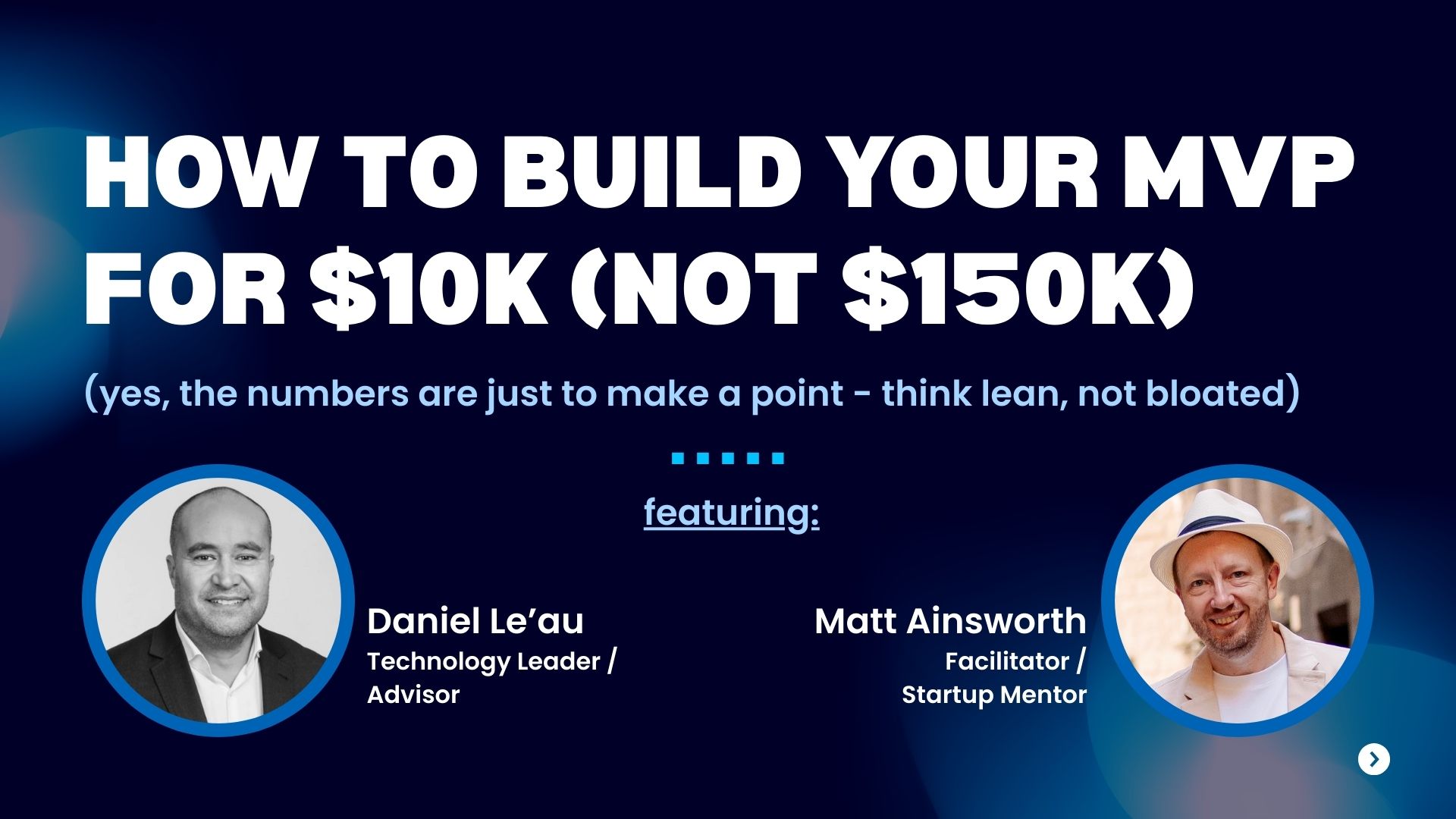
AI makes it easier than ever to build a product.
It does not make it easier to build the right product.
If you’re a non-technical founder building software, automation, or AI, your MVP can quietly turn into a $150k+ experiment because of:
- scope creep
- tool chaos
- unclear decisions
- and “trusting the process” with the wrong people
This post includes:
- the full workshop replay
- the 4 traps that blow MVP budgets
- a lean MVP checklist you can use this week
- and simple guardrails to stay in control without becoming technical
Quick answer
If you want a $10k-style MVP (lean), you need:
- a smaller scope than you think
- weekly shipping
- a clear “no new tools” rule
- and kill rules that stop over-building early
Watch the workshop (replay)
What this workshop is for:
If you’ve been:
- searching for a CTO before writing a line of code
- burned by an agency or freelancer
- overwhelmed by AI tools and scope creep
- unsure what actually needs to be in your MVP
This is the safer path: build lean, validate faster, and stop paying for bloat.
The $10k MVP vs the $150k MVP (what’s actually different):
| Category | $10k Lean MVP | $150k+ Bloated MVP |
|---|---|---|
| Goal | Validate a workflow fast | Build “the product” too early |
| Scope | 1 core user path | 10 features + edge cases |
| Tools | Boring defaults | Tool sprawl + custom everything |
| Delivery | Weekly demos | “Trust us, it’s coming” |
| Quality | Good enough to test | Overbuilt before demand |
| Risk | Low, reversible | High, locked-in |
This isn’t about the exact number.
It’s about lean decisions vs bloated decisions.
The 4 traps that quietly blow MVP budgets to $100k+:
Trap #1: The “feature list MVP”
Founders accidentally treat the MVP like a mini version of the final product.
Reality:
- An MVP is not “all features but smaller.”
- An MVP is one job-to-be-done, proven in the real world.
Red flag: you can’t describe the MVP in one sentence.
Trap #2: No scope boundaries (everything is “important”)
If everything is important, nothing ships.
You need explicit scope boundaries like:
- “No admin dashboard in V1”
- “No roles/permissions until users pay”
- “No mobile app until the web flow works”
Red flag: the dev plan is “build everything in parallel.”
Trap #3: Tool chaos (Frankenstack builds)
This happens when every problem gets solved by “adding one more tool.”
It starts harmless:
- one automation
- one plugin
- one extra database
- one extra AI service
Then nobody knows what connects to what.
Red flag: “We added it because it was faster” becomes a habit.
Trap #4: Blind trust in timelines and complexity
Non-technical founders get burned when:
- timelines are vague
- progress is invisible
- everything takes “2 more weeks”
A lean build requires:
- proof-of-work
- weekly demos
- clear milestones
- visible progress
Red flag: you can’t click a staging link every week.
What a truly lean MVP includes (and what it doesn’t):
A lean MVP must include:
- one clear user type
- one core action (the “moment of value”)
- a basic input/output loop
- a way to capture feedback
- minimal analytics (even basic usage tracking)
A lean MVP does NOT need:
- advanced dashboards
- complex permissions
- 5 integrations
- perfect UI polish
- scalability work “just in case”
Week 1: what to do next (practical steps)
If you want to keep costs down immediately, do this:
- Write a 1-page MVP scope
- user
- problem
- 3 core actions
- what “done” means
- Create “kill rules” Example: “If users don’t complete the workflow in 7 days, we pause new features and fix onboarding.”
- Define weekly shipping criteria Example: “Every Friday we demo something clickable.”
- Lock stack guardrails Example: “No new tools unless we remove one.”
MVP Cost Control Checklist:
Use this before you pay anyone serious money.
Scope guardrails
- MVP described in one sentence
- One core workflow only
- Clear “not in V1” list
Delivery guardrails
- Weekly demo cadence
- Staging link you can click
- Milestones defined before build
Cost guardrails
- Budget cap per month
- No scope changes without tradeoffs
- “Pause and fix” rule for spirals
Ownership guardrails
- You own GitHub, hosting, domain, database
- You have access to all accounts
- Documentation exists for key decisions
Free Guide: The 5 Signs Your AI or Tech Build Is About to Go Wrong
If you’re overwhelmed by tech and AI choices, this saves you time and expensive mistakes.
The 5 Signs Your AI or Tech Build Is About to Go Wrong
It helps you spot the warning signs that derail early builds – based on what you actually need to know, not hype.
👉 Download it free here → Get the 5 Signs Guide
If you want help installing this system:
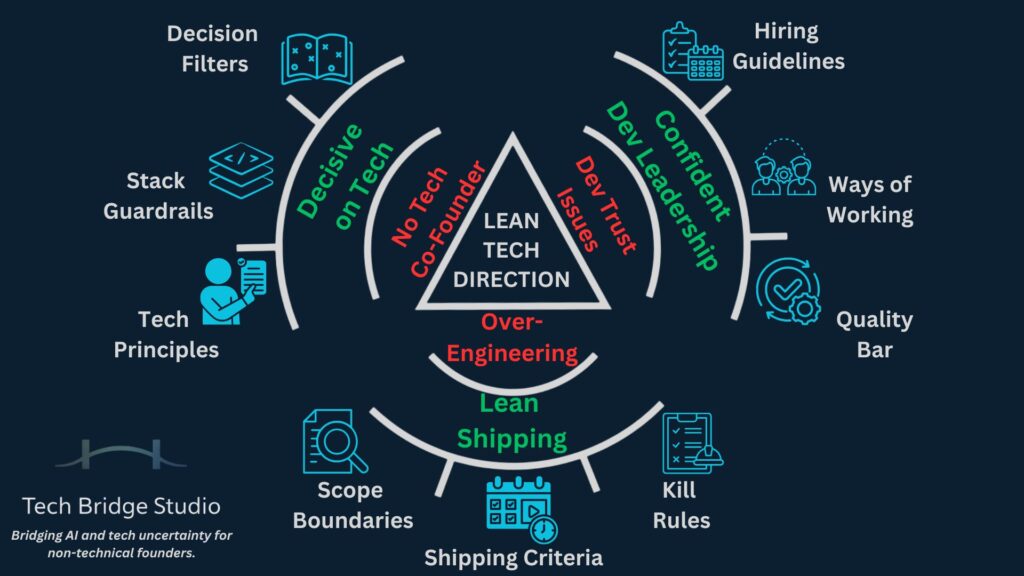
If you’re a non-technical founder who wants:
- clear AI and tech principles you can hand to any developer
- guardrails that stop over-engineering before it starts
- the skills to hire, brief, and manage devs without being technical
- a lean scope and a shipping rhythm that actually holds
That’s exactly what Lean Tech Direction installs in 90 days.
👉 Apply here: To Start the Lean Tech Direction Program
FAQ:
How much does an MVP cost in 2026?
It depends on scope, but most blowouts happen because the MVP becomes the full product too early. Lean MVPs stay small and testable.
Can I build an MVP for $10k?
Sometimes, yes, if you keep scope tight and use guardrails. The point is to avoid unnecessary bloat, not hit an exact number.
Is an agency or freelancer better for an MVP?
Freelancer can be cheaper but riskier without strong structure. Agencies can move faster but often push scope unless you set guardrails.
Do I need a CTO to build an MVP?
Not usually. You need tech direction, guardrails, and visible shipping — not a mythical perfect cofounder.
How do I prevent scope creep?
Weekly demos, a “not in V1” list, and kill rules that stop the build from expanding without evidence.

2 responses to “How to Build Your MVP for $10k (Not $150k): Workshop Replay + Notes”
[…] • minimal […]
[…] How to Build Your MVP for $10k (Not $150k) – if you missed this session you can watch the replay here. […]