
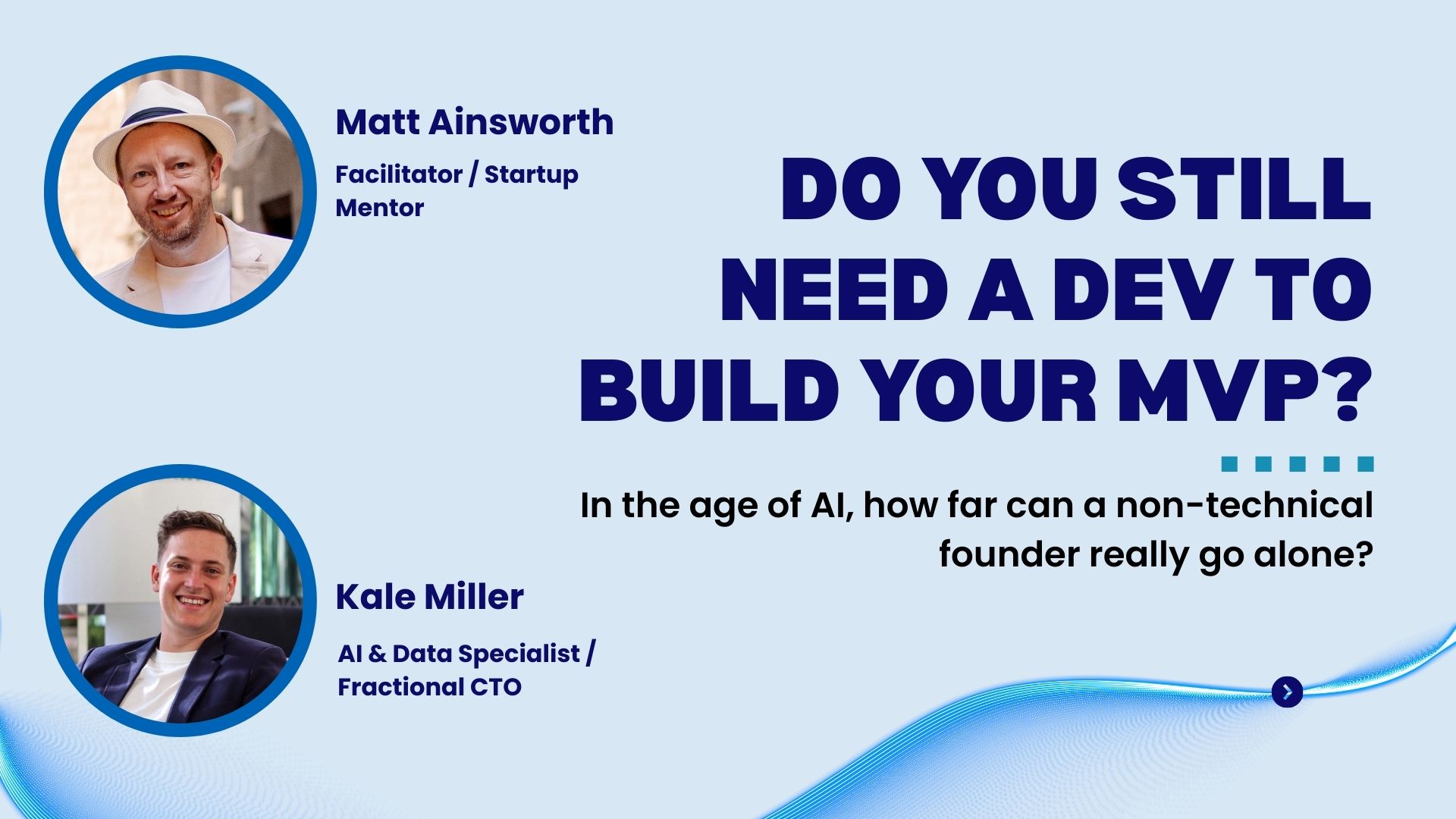
There’s a version of this question that comes up in almost every conversation I have with non-technical founders right now.
“I’ve been using [AI tool]. Do I actually need a developer?”
It’s the right question. And it deserves a straight answer – not a “it depends” that leaves you exactly where you started.
The honest answer is: sometimes no. Sometimes yes. And the difference between those two calls is what this article – and the webinar below – is actually about.
Watch the Full Session
We recorded this as a free webinar with Kale Miller, Fractional CTO and Founder of Prometheus AI. Kale has built data and AI systems from 0 to 1 and led engineering teams. He knows what’s possible with AI tools alone – and where the floor drops out.
Want the worksheet? You can grab it here.
If you’re planning to build in the next 3-6 months, this is worth your time before you make any hiring decisions.
Why This Question Is Harder to Answer in 2026
A year ago, the answer was almost always “yes, you need a developer.”
Now it’s genuinely more complicated. AI tools have changed what a non-technical founder can build alone – prototypes that used to take a developer six weeks can now be put together in days. That’s real. That’s not hype.
But here’s what hasn’t changed.
AI makes it easier to build. It does not make it easier to build the RIGHT thing.
And if you’re moving fast without clear tech direction, AI tools can accelerate your mistakes just as quickly as your progress. I’ve watched founders use vibe-coding tools to build impressive-looking prototypes that needed complete rewrites the moment they tried to charge money for them. The tool didn’t cause the problem. The lack of guardrails did.
So the question isn’t really “do I need a developer.” The question is: where are you in the build, and what does the next stage actually require?
When AI Tools Are Genuinely Enough
If you are at the idea validation stage – testing whether people want the thing before you invest in building it properly – AI tools are often not just enough, they’re the right call.
Specifically, you probably don’t need a developer yet if:
- You’re building a prototype to show investors or early users, not to charge money
- You’re testing one specific assumption before committing to a full build
- Your “product” is mostly workflow automation that doesn’t touch sensitive data
- You need something in days, not weeks, and quality is secondary to speed
The risk at this stage isn’t building with AI tools. The risk is mistaking a validated prototype for a shippable product – and skipping the step that turns one into the other.
For more on what actually separates a prototype from an MVP, that article covers the definitions in plain English.
When You’re Entering Risky Territory
This is where most non-technical founders get into trouble. Not because they made a bad decision, but because nobody told them the terrain had changed.
You’re in risky territory when:
The prototype is starting to handle real user data. Security, privacy, and data handling are not things AI tools manage for you. The moment real users are inputting real information, you need someone who understands what that means technically.
You’re about to charge money. This is the single clearest line in the sand. A prototype that “works” and a product someone is paying for are not the same thing. The reliability standard, the error handling, the edge cases – everything changes. What changes when you start charging money is worth reading before you make that call.
You’ve changed your scope or stack once already. If you’ve already pivoted once before launching, that’s a yellow flag. If you’ve done it twice, stop. You don’t have a tool problem. You have a decision process problem – and adding a developer without fixing that first won’t help.
You’re adding AI features because competitors seem to have them. This is one of the 5 signs your build is going wrong – and it’s the most expensive mistake I’m seeing in 2026. AI features added without a clear user problem to solve are just complexity. Complexity kills early-stage products.
When to Bring in a Developer
The clearest signal is this: when the gap between what you need and what AI tools can reliably produce starts costing you users or revenue.
More specifically, bring in a developer when:
- Users are ready to pay and the product isn’t stable enough to charge for
- You need integrations with external systems that require real API work
- You’re handling payments, authentication, or sensitive data
- The prototype is being rebuilt every few weeks because the foundation isn’t solid
- You can’t answer “what would it take to hand this to someone else” without the answer being “start again”
At this stage, whether you need a developer comes down to what you’re actually trying to build – and how much the failure costs if it breaks.
When a CTO Actually Makes Sense
Later than most founders think.
A CTO is not a senior developer. A CTO is a technical decision-maker and team leader. You don’t need one until you have a team to lead and decisions that require someone embedded full-time.
For most early-stage founders, what a CTO actually does is a better question to start with than “should I find one.” The honest answer for most founders at the prototype or early MVP stage is: not yet. What you need first is a decision framework – so that whoever you eventually bring in is working from a clear brief, not rebuilding from scratch because the direction kept shifting.
The Real Question Underneath All of This
Every founder who asks “do I need a developer” is really asking something else.
They’re asking: am I making the right calls on this build, or am I about to waste six months and a significant amount of money finding out I wasn’t?
That’s the question Lean Tech Direction is built to answer.
Not by making you technical. By giving you the framework, the guardrails, and the decision filters to lead the build confidently – with or without a developer in the room.
Free Download: The 5 Signs Your AI or Tech Build Is About to Go Wrong
Before you decide whether to hire a developer, it’s worth knowing whether your current build is already showing warning signs.
The guide covers the five patterns that show up before almost every painful build failure – and what to do about each one.
Want to lead your AI or tech build without a CTO?
Lean Tech Direction is a 90-day program for non-technical founders who are done guessing about tech and ready to lead the build confidently.
In 90 days you’ll go from second-guessing every technical decision to:
- Clear AI and tech principles you can hand to any developer
- Guardrails that stop over-engineering before it starts
- The skills to hire, brief, and manage devs without being technical
- A lean scope and a shipping rhythm that actually holds
Apply for the Lean Tech Direction Program
FAQ
Do I need a developer to build my MVP in 2026?
Not always – especially at the prototype and validation stage. AI tools have made it possible for non-technical founders to build and test ideas faster than ever. The line to watch is when you move from prototype to a product people are paying for. That’s when the reliability and security requirements change significantly, and most founders need technical support to cross that gap properly.
How far can a non-technical founder build alone with AI tools?
Further than most people think at the idea stage. Not as far as most people hope at the production stage. AI tools are excellent for testing assumptions quickly and cheaply. They are not a replacement for solid technical foundations when real users and real money are involved.
When should I hire a developer as a non-technical founder?
The clearest trigger is when users are ready to pay and the product isn’t stable enough to support that. Other clear signals: you’re handling real user data, you need external integrations, or you’ve already rebuilt the same feature multiple times without a stable foundation.
What’s the difference between a prototype and an MVP?
A prototype tests an assumption. An MVP is something you charge money for and are prepared to support. The standards for reliability, security, error handling, and scalability are completely different. Many founders skip the step between them – which is where most expensive rebuilds come from.
Do I need a CTO as a non-technical founder?
Later than most founders think. A CTO makes sense when you have a team to lead and decisions that need someone embedded full-time. Most early-stage founders need a decision framework first, not a CTO. The framework is what makes any technical hire you bring in actually effective.
How do I avoid expensive rebuilds as a non-technical founder?
Install decision filters before you build, not after. Define what “done” looks like for each feature before it starts. Ask your developer the five questions that separate good technical decisions from expensive ones. And never add AI features without a clear answer to: what user problem does this solve, for whom, and how do we know they have it?
